100 Best AI Tools in 2026 (Free & Paid)
Artificial intelligence is no longer just for tech companies. In 2026, AI has become a practical tool for students, professionals, creators, developers, educators, marketers, and businesses of every size.
Whether you want to write faster, create videos, build websites, analyse data, design graphics, or improve productivity, there's an AI tool built for the job.
This guide highlights the 100 best AI tools in 2026, carefully organised by category to help you quickly find the right solution. You'll also discover how to choose the best tool for your needs, avoid common mistakes, and get the most value from free and paid options.
If you're interested in more technology updates, explore our Technology section:
https://www.tefetimes.com/technology
https://www.tefetimes.com/technology
Search Intent Analysis
| Primary Keyword | Best AI Tools 2026 |
| Search Intent | Informational |
| Audience | Students, professionals, businesses, creators |
| Difficulty | High |
| Content Goal | Complete resource guide |
Why AI Tools Matter More Than Ever
AI tools now help people save hours every week. Rather than replacing creativity, they improve productivity by handling repetitive tasks and offering intelligent suggestions.
Common benefits include:
- Faster research
- Better writing
- Smarter coding
- Automated workflows
- Professional-quality images
- Video creation
- Language translation
- Business analytics
- Learning support
- Customer service
Many beginners struggle with choosing the right software because hundreds of AI tools now exist. That's why we've organised this guide into practical categories.
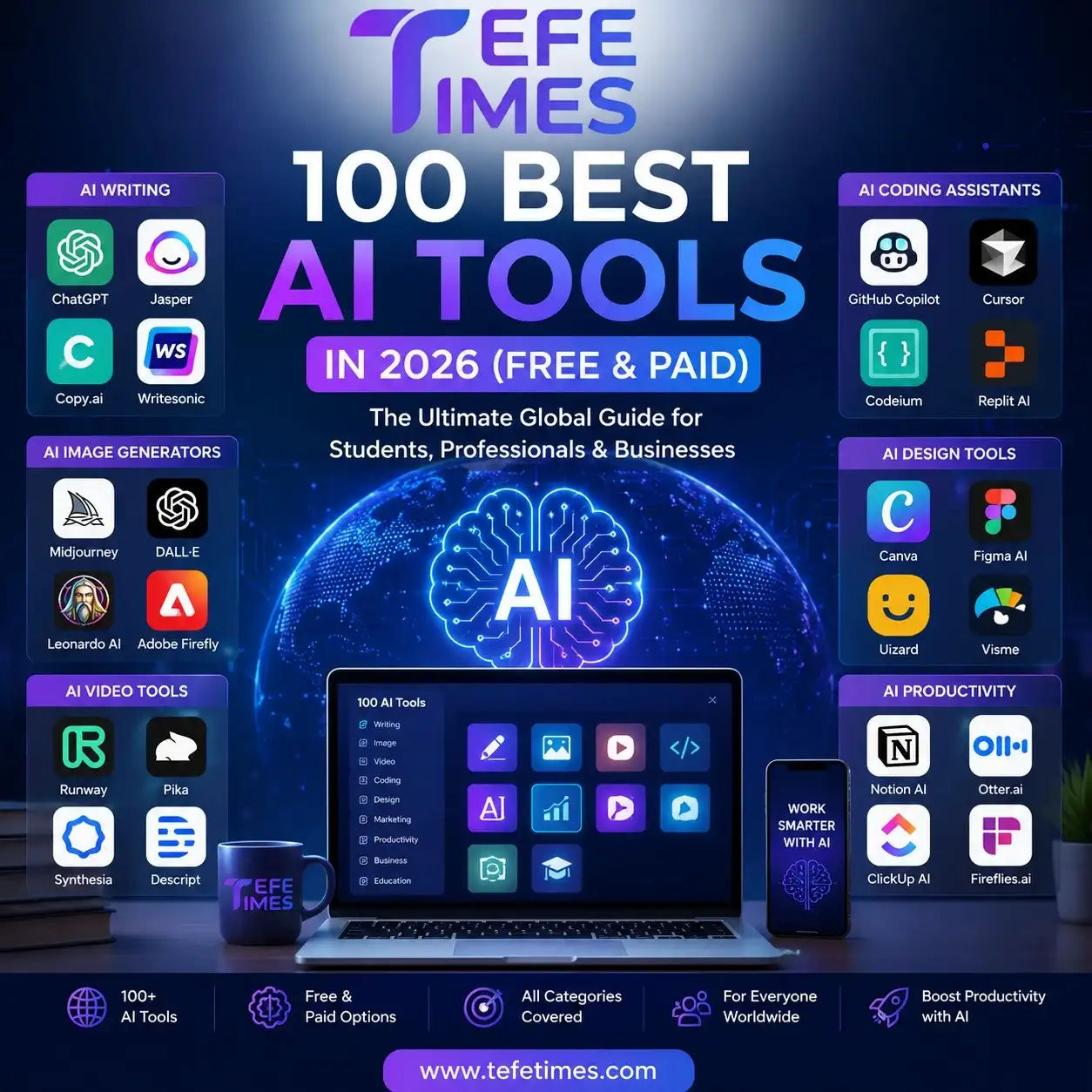
100 Best AI Tools in 2026
AI Chatbots & General Assistants
- ChatGPT
- Claude
- Google Gemini
- Microsoft Copilot
- Perplexity AI
- Poe
- Grok
- Pi AI
- You.com AI
- Meta AI
AI Writing Tools
- Jasper
- Copy.ai
- Writesonic
- Rytr
- Grammarly
- QuillBot
- Wordtune
- Sudowrite
- Notion AI
- HyperWrite
AI Image Generators
- Midjourney
- Adobe Firefly
- DALL·E
- Leonardo AI
- Ideogram
- Stable Diffusion
- Playground AI
- Flux AI
- DreamStudio
- Canva Magic Media
AI Video Creation Tools
- Runway
- Pika
- Synthesia
- HeyGen
- Veo
- Luma AI
- InVideo AI
- Kling AI
- CapCut AI
- Descript
AI Coding Assistants
- GitHub Copilot
- Cursor
- Windsurf
- Codeium
- Replit AI
- Amazon Q Developer
- Tabnine
- Continue
- Blackbox AI
- Sourcegraph Cody
AI Design Tools
- Canva Magic Studio
- Adobe Express AI
- Figma AI
- Uizard
- Visme AI
- Microsoft Designer
- Framer AI
- Designs.ai
- Khroma
- Looka
AI Productivity Tools
- Notion AI
- Motion
- ClickUp AI
- Mem AI
- Taskade
- Fireflies.ai
- Otter.ai
- Krisp
- Rewind
- Superhuman AI
AI Marketing Tools
- Surfer SEO
- Semrush AI Toolkit
- Ahrefs AI
- HubSpot AI
- Mailchimp AI
- AdCreative.ai
- Ocoya
- Predis.ai
- Phrasee
- Unbounce AI
AI Education Tools
- Khanmigo
- Quizlet AI
- TutorAI
- Elicit
- Wolfram AI
- Socratic
- Duolingo Max
- Consensus
- Study Fetch
- Mindgrasp
AI Business & Analytics
- Salesforce Einstein
- Zoho Zia
- Tableau AI
- Power BI Copilot
- Airtable AI
- Gong
- Lavender
- Beautiful.ai
- Gamma
- Tome
Free vs Paid AI Tools
| Cost | No | Monthly subscription |
| Features | Basic | Advanced |
| Speed | Standard | Faster |
| Collaboration | Limited | Full |
| API Access | Rare | Usually available |
| Best For | Beginners | Businesses |
How to Choose the Right AI Tool
Instead of trying every tool, ask yourself these questions:
- What problem am I solving?
- Do I need free or premium features?
- Will I use it daily?
- Does it integrate with my workflow?
- Is my data protected?
For example:
- Students may benefit from Quizlet AI and Khanmigo.
- Developers often choose GitHub Copilot or Cursor.
- Designers frequently use Midjourney or Adobe Firefly.
- Marketers rely on Surfer SEO and Semrush AI.
Best AI Tools by Use Case
| Writing | ChatGPT, Jasper |
| Coding | GitHub Copilot |
| SEO | Surfer SEO |
| Design | Canva Magic Studio |
| Video | Runway |
| Presentations | Gamma |
| Research | Perplexity AI |
| Learning | Khanmigo |
| Meetings | Fireflies.ai |
| Productivity | Notion AI |
Real-World Example
Imagine a small business owner launching a new product.
They could:
- Use ChatGPT to draft product descriptions.
- Create visuals with Adobe Firefly.
- Design social posts in Canva Magic Studio.
- Generate promotional videos using Runway.
- Optimise website content with Surfer SEO.
- Analyse campaign results through Power BI Copilot.
This streamlined workflow helps save time while maintaining quality.
Common Mistakes to Avoid
Many beginners make these errors:
- Using multiple tools for the same task without a clear purpose.
- Ignoring privacy settings before uploading sensitive information.
- Expecting perfect results without reviewing the output.
- Paying for premium plans before testing free versions.
- Choosing tools based only on popularity instead of actual needs.
Budget-Friendly AI Setup
You don't need expensive software to be productive.
A practical low-cost toolkit could include:
- ChatGPT (Free)
- Canva Free
- Grammarly Free
- Perplexity AI
- Notion AI
- GitHub Copilot (if you're a developer)
As your requirements grow, you can upgrade to premium versions that offer advanced collaboration, automation, and integrations.
Expert Tips
- Master one AI tool before adding more.
- Combine specialised tools instead of relying on a single platform.
- Keep prompts clear and specific.
- Verify important facts with trusted sources.
- Stay updated because AI products evolve rapidly.
Future Trends
AI continues to evolve at a remarkable pace. Some developments expected to shape the coming years include:
- More personalised AI assistants.
- Better multimodal capabilities combining text, images, audio, and video.
- Stronger collaboration features for remote teams.
- Increased focus on privacy and responsible AI.
- Industry-specific tools for healthcare, education, finance, and engineering.
Keeping up with these trends will help individuals and organisations make informed technology decisions.
Trusted Resources
For readers who want to explore AI research and standards further, these organisations provide reliable information:
Key Takeaways
- AI tools can improve productivity across writing, coding, design, education, and business.
- Free versions are excellent for learning and everyday tasks.
- Premium plans are best suited to professionals and organisations with advanced requirements.
- Choosing the right tool depends on your goals, workflow, and budget.
- Staying informed about new AI developments helps you adapt as technology evolves.
10. FAQ Section
Which is the best AI tool in 2026?
There isn't a single best option. ChatGPT, Claude, Google Gemini, GitHub Copilot, Midjourney, and Runway are among the most popular, depending on your use case.
Are free AI tools good enough?
Yes. Many free AI tools provide powerful features for students, hobbyists, and small businesses. Paid plans usually unlock higher limits, advanced capabilities, and team features.
Which AI tool is best for students?
Khanmigo, Quizlet AI, ChatGPT, Perplexity AI, and Notion AI are excellent choices for learning, research, and study support.
Which AI tool is best for coding?
GitHub Copilot, Cursor, Codeium, and Windsurf are widely used by developers for code generation, debugging, and productivity.
Which AI tool is best for content creation?
ChatGPT, Jasper, Canva Magic Studio, Adobe Firefly, Runway, and Descript work well together for creating written, visual, and video content.
Is it safe to use AI tools?
Most reputable AI tools include privacy controls, but always review their data policies and avoid uploading sensitive or confidential information unless you understand how it will be handled.