
Introduction
Skyscrapers have always represented more than just steel, glass, and concrete. They reflect ambition, economic power, architectural innovation, and the desire to push human limits higher than ever before. In 2026, the race to build taller, smarter, and more sustainable skyscrapers continues to capture global attention.
From the deserts of Dubai to the rapidly evolving skylines of China and Southeast Asia, the world’s tallest buildings are engineering masterpieces that attract millions of tourists, investors, architects, and curious travelers every year.
You might be wondering why people are still obsessed with building taller towers when cities already struggle with overcrowding, sustainability, and rising construction costs. Here is the truth: skyscrapers are no longer just office buildings. They are symbols of national identity, luxury living, tourism, technology, and future urban planning.
Today’s tallest towers include:
- Luxury hotels
- Observation decks
- Residential apartments
- Smart offices
- Entertainment hubs
- Eco-friendly systems
- Advanced safety engineering
And the competition is far from over.
In this detailed guide, you will discover the top 10 tallest buildings in the world in 2026, fascinating facts about each structure, architectural highlights, construction challenges, and the future of supertall skyscrapers.
If you love architecture, travel, engineering, or modern city design, this list will give you a deep look into the giants shaping the global skyline.
What Defines a Tallest Building?
Before diving into the rankings, it is important to understand how skyscraper heights are officially measured.
The global authority that ranks tall buildings is the Council on Tall Buildings and Urban Habitat (CTBUH). They measure height based on:
- Architectural top
- Permanent structural elements
- Spires
- Occupied floors
However, antennas and temporary structures are usually excluded from official rankings.
This is where many beginners get confused. A building may appear taller because of antennas, but officially it may rank lower.
For example:
- A decorative spire counts
- A communication antenna usually does not.
Another important term is “supertall skyscraper.” Buildings over 300 meters fall into this category, while structures exceeding 600 meters are often called “megatall” buildings.
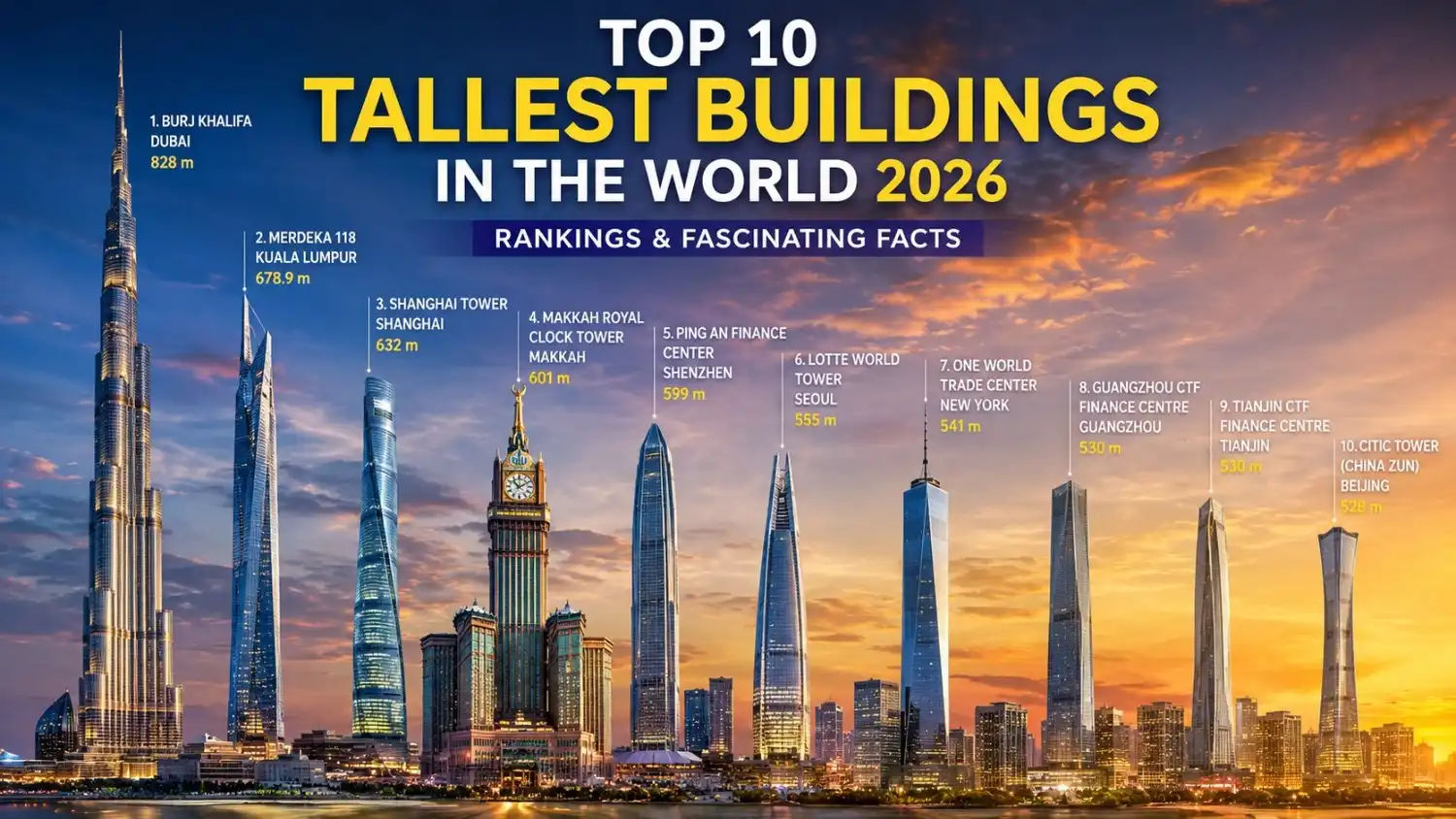
Top 10 Tallest Buildings in the World in 2026
1. Burj Khalifa – Dubai, UAE
Height: 828 meters (2,717 feet)
Floors: 163
Completed: 2010
Floors: 163
Completed: 2010
The Burj Khalifa remains the tallest building in the world in 2026, and honestly, it still dominates the skyline in a way few buildings ever have.
Located in Dubai, this megatall skyscraper became an instant global icon after its completion. Designed by architect Adrian Smith from SOM, the tower’s futuristic design was inspired by the Hymenocallis flower.
Fascinating Facts About Burj Khalifa
- The tower contains residential apartments, offices, restaurants, and hotels
- It has one of the highest observation decks in the world
- The elevators travel at incredible speeds
- The building can be seen from nearly 95 kilometers away on a clear day
- It uses advanced cooling systems to survive Dubai’s extreme heat
One thing that really matters is the engineering behind the structure. Dubai faces intense desert winds and temperatures, so the tower’s Y-shaped design helps reduce wind pressure and improve stability.
Tourists from around the world visit the Burj Khalifa every year, making it one of the most recognizable landmarks globally.
2. Merdeka 118 – Kuala Lumpur, Malaysia
Height: 678.9 meters
Floors: 118
Completed: 2023
Floors: 118
Completed: 2023
Merdeka 118 has quickly become one of the most talked-about skyscrapers in the world.
Located in Kuala Lumpur, this tower officially became the second tallest building globally after surpassing the Shanghai Tower.
The building’s sharp, crystalline exterior gives it a unique visual identity. Its design was inspired by Malaysia’s cultural heritage and independence history.
What Makes Merdeka 118 Special?
- It includes luxury offices, hotels, retail areas, and observation decks
- The tower features sustainable construction techniques
- It was designed to achieve green building certifications
- The spire dramatically increases its architectural height
In real-world situations, modern skyscrapers are expected to balance luxury with sustainability. Merdeka 118 represents this shift perfectly.
3. Shanghai Tower – Shanghai, China
Height: 632 meters
Floors: 128
Completed: 2015
Floors: 128
Completed: 2015
Shanghai Tower remains one of the most advanced skyscrapers ever built.
Unlike many towers that focus mainly on height, Shanghai Tower emphasizes energy efficiency and smart engineering.
Its twisting design is not just for aesthetics. The spiral shape reduces wind loads significantly, helping save millions in construction materials.
Key Features
- Double-skin glass façade for insulation
- Wind turbines integrated into the building
- Rainwater recycling systems
- High-speed elevators among the fastest globally
Most people ignore this part: tall buildings consume enormous amounts of energy. Shanghai Tower’s eco-friendly systems show how future skyscrapers can reduce environmental impact.
4. Makkah Royal Clock Tower – Saudi Arabia
Height: 601 meters
Floors: 120
Completed: 2012
Floors: 120
Completed: 2012
The Makkah Royal Clock Tower stands beside the Grand Mosque in Mecca and serves millions of pilgrims every year.
The building is famous for its enormous clock faces, which are visible from miles away.
Interesting Facts
- The clock is one of the largest in the world
- The tower includes a luxury hotel
- It contains prayer rooms and Islamic museums
- The structure was built to accommodate growing pilgrimage tourism
This skyscraper combines religious significance with modern engineering in a way few structures do.
5. Ping An Finance Center – Shenzhen, China
Height: 599 meters
Floors: 115
Completed: 2017
Floors: 115
Completed: 2017
Shenzhen has transformed into a global technology and finance hub, and Ping An Finance Center reflects that rapid growth.
The tower’s sleek stainless-steel exterior gives it a clean and futuristic appearance.
Highlights
- Houses offices, retail spaces, and conference centers
- Built with advanced earthquake resistance technology
- Designed for strong typhoon resistance
The good news is that modern skyscraper engineering has become much safer than earlier decades. Buildings like Ping An Finance Center are designed to survive extreme weather conditions.
6. Lotte World Tower – Seoul, South Korea
Height: 555 meters
Floors: 123
Completed: 2016
Floors: 123
Completed: 2016
Lotte World Tower combines luxury, tourism, entertainment, and business in one massive vertical city.
Its elegant tapered shape was inspired by traditional Korean art and ceramics.
Why Tourists Love It
- Massive observation deck with glass floors
- Luxury hotel and residences
- Shopping malls and entertainment areas
- Stunning nighttime skyline views
One thing many travelers notice is how integrated modern skyscrapers have become with urban lifestyles. Lotte World Tower is not just a building—it is an entire experience.
7. One World Trade Center – New York, USA
Height: 541 meters
Floors: 104
Completed: 2014
Floors: 104
Completed: 2014
One World Trade Center carries deep emotional and historical significance.
Built after the tragic events of September 11, the tower symbolizes resilience, rebuilding, and hope.
Important Facts
- It is the tallest building in the United States
- The height of 1,776 feet references American independence
- Advanced security and safety systems were prioritized heavily
This is where architecture becomes emotional rather than purely functional.
The building also attracts millions of visitors to its observatory every year.
8. Guangzhou CTF Finance Centre – Guangzhou, China
Height: 530 meters
Floors: 111
Completed: 2016
Floors: 111
Completed: 2016
Guangzhou CTF Finance Centre is known for speed, efficiency, and mixed-use design.
Standout Features
- Extremely fast elevators
- Luxury residences and hotels
- Efficient structural engineering
- Advanced environmental systems
China continues to dominate global skyscraper development because of rapid urbanization and economic expansion.
9. Tianjin CTF Finance Centre – Tianjin, China
Height: 530 meters
Floors: 98
Completed: 2019
Floors: 98
Completed: 2019
Although tied in height with Guangzhou CTF Finance Centre, Tianjin’s tower has a distinct aerodynamic design.
Unique Characteristics
- Curved exterior reduces wind resistance
- Mixed-use vertical city concept
- Advanced seismic engineering
This tower reflects a growing trend where skyscrapers function as self-contained urban ecosystems.
10. CITIC Tower (China Zun) – Beijing, China
Height: 528 meters
Floors: 109
Completed: 2018
Floors: 109
Completed: 2018
CITIC Tower, often called China Zun, has become a defining feature of Beijing’s skyline.
Its shape resembles an ancient Chinese ceremonial vessel known as a “zun.”
What Makes It Unique?
- Strong cultural influence in architecture
- Advanced earthquake protection systems
- Smart building management technologies
Many modern skyscrapers now integrate cultural symbolism into their designs rather than focusing only on height.
Comparison Table of the Tallest Buildings in 2026
| 1 | Burj Khalifa | UAE | 828 m |
| 2 | Merdeka 118 | Malaysia | 678.9 m |
| 3 | Shanghai Tower | China | 632 m |
| 4 | Makkah Royal Clock Tower | Saudi Arabia | 601 m |
| 5 | Ping An Finance Center | China | 599 m |
| 6 | Lotte World Tower | South Korea | 555 m |
| 7 | One World Trade Center | USA | 541 m |
| 8 | Guangzhou CTF Finance Centre | China | 530 m |
| 9 | Tianjin CTF Finance Centre | China | 530 m |
| 10 | CITIC Tower | China | 528 m |
Why Countries Build Ultra-Tall Skyscrapers
Many people assume skyscrapers are built only for luxury or tourism. That is partially true, but there are deeper reasons.
Economic Growth
Tall buildings often symbolize strong economic development. Cities compete globally to attract:
- Investors
- International businesses
- Tourists
- Luxury buyers
Limited Urban Space
As cities become crowded, vertical development becomes necessary.
Instead of spreading outward, cities build upward.
National Pride
Countries often use iconic skyscrapers to showcase technological advancement and modernization.
Dubai is a perfect example. The Burj Khalifa transformed the city into a global tourism and business destination.
Engineering Challenges Behind Tall Buildings
Building a megatall skyscraper is far more complicated than most people realize.
Wind Resistance
At extreme heights, wind becomes a major threat.
Architects use:
- Aerodynamic shapes
- Tuned mass dampers
- Flexible structural systems
to reduce sway and improve stability.
Earthquakes
In earthquake-prone regions like China and Japan, skyscrapers require advanced seismic engineering.
Modern towers can absorb shock waves and move safely during tremors.
Elevator Technology
Traditional elevators are not practical for megatall buildings.
Modern towers use:
- Double-deck elevators
- High-speed systems
- Smart traffic management
to move thousands of people efficiently.
Water Pressure Systems
Supplying water hundreds of meters into the air requires powerful pumping systems and carefully designed infrastructure.
Sustainability in Modern Skyscrapers
One major trend in 2026 is green skyscraper development.
This is becoming increasingly important because large buildings consume enormous amounts of energy.
Sustainable Features Include
Solar Energy Integration
Many towers now include solar panels.
Rainwater Harvesting
Collecting rainwater helps reduce water waste.
Smart Climate Control
AI-powered systems optimize cooling and heating efficiency.
Energy-Efficient Glass
Modern façades reduce heat transfer significantly.
Shanghai Tower remains one of the best examples of sustainable skyscraper engineering.
Future Tallest Buildings Under Development
The race for height is not over.
Several upcoming projects could eventually surpass the Burj Khalifa.
Jeddah Tower – Saudi Arabia
Jeddah Tower aims to exceed 1,000 meters in height.
If completed successfully, it will become the first kilometer-high skyscraper in history.
Construction delays have slowed progress, but the project still represents the future of megatall architecture.
The Rise of Smart Vertical Cities
Future skyscrapers may include:
- AI-managed systems
- Drone delivery hubs
- Vertical farming
- Autonomous transportation integration
Cities are evolving rapidly, and skyscrapers will play a huge role in future urban planning.
Common Mistakes People Make When Comparing Tall Buildings
Confusing Height Measurements
Many people compare antenna height rather than official architectural height.
Ignoring Occupied Floors
Some buildings are taller structurally but have fewer usable floors.
Assuming Taller Means Better
Height alone does not define architectural quality.
Some shorter buildings are more technologically advanced and sustainable.
Real-Life Impact of Skyscrapers on Cities
Skyscrapers dramatically change urban environments.
Tourism Growth
Buildings like Burj Khalifa generate billions through tourism, shopping, hotels, and entertainment.
Increased Property Value
Areas around iconic skyscrapers often experience major real estate growth.
Urban Transformation
Entire city districts can emerge around landmark towers.
Dubai’s downtown area is one of the clearest examples of this transformation.
Expert Tips for Travelers Visiting Famous Skyscrapers
If you plan to visit these towers, timing matters more than most people think.
Visit Observation Decks Before Sunset
You get:
- Daylight city views
- Sunset photography
- Night skyline experiences
all in one visit.
Book Tickets Early
Popular skyscraper attractions often sell out quickly.
Avoid Weekend Crowds
Weekday mornings are usually less crowded.
Check Weather Conditions
Fog and haze can ruin skyline visibility.
Lesser-Known Facts About the World’s Tallest Buildings
Buildings Slightly Move
Yes, skyscrapers naturally sway with wind movement.
This movement is usually safe and carefully engineered.
Lightning Strikes Are Common
Tall buildings are struck by lightning frequently but are protected with advanced grounding systems.
Window Cleaning Takes Weeks
Cleaning exterior glass on megatall towers is a massive operation involving specialized equipment and teams.
How Skyscrapers Influence Modern Architecture
Modern skyscrapers are influencing:
- Sustainable urban design
- Smart city planning
- Vertical living concepts
- High-density development
Architects are now focusing more on livability rather than simply building taller structures.
This shift matters because cities of the future must balance:
- Population growth
- Environmental concerns
- Energy efficiency
- Human comfort
The Psychology Behind Tall Buildings
There is also a psychological reason humans admire skyscrapers.
Tall structures create feelings of:
- Progress
- Achievement
- Power
- Innovation
Throughout history, civilizations have built monumental structures to symbolize greatness.
Today’s skyscrapers are modern versions of that same human ambition.
Frequently Asked Questions
What is the tallest building in the world in 2026?
The Burj Khalifa in Dubai remains the tallest building in the world at 828 meters.
Which country has the most skyscrapers in the top 10 list?
China dominates the list with multiple entries, including Shanghai Tower, Ping An Finance Center, and CITIC Tower.
Will any building become taller than Burj Khalifa?
Jeddah Tower in Saudi Arabia is expected to surpass Burj Khalifa if completed successfully.
Why are skyscrapers important?
They support urban growth, business development, tourism, and efficient land use in crowded cities.
Are supertall buildings safe?
Yes. Modern skyscrapers use advanced engineering systems for earthquakes, wind resistance, fire safety, and structural stability.
Which skyscraper has the best observation deck?
Many travelers consider Burj Khalifa and Lotte World Tower among the best for panoramic city views.
Why do skyscrapers sway?
Buildings are designed to move slightly with wind forces to reduce structural stress and improve safety.
What is a megatall skyscraper?
A megatall skyscraper is a building taller than 600 meters.
Final Thoughts
The world’s tallest buildings are far more than engineering records. They represent innovation, economic ambition, cultural identity, and humanity’s constant desire to push boundaries higher.
From the iconic Burj Khalifa to the rapidly rising towers of Asia, skyscrapers continue to reshape how modern cities function and how people experience urban life.
What makes 2026 especially interesting is the growing shift toward sustainability, smart technology, and mixed-use vertical communities. Future skyscrapers will not only be taller—they will likely become smarter, greener, and more integrated into everyday life.
If you are passionate about architecture, travel, urban development, or engineering, keeping an eye on the evolving skyline is genuinely fascinating. The next decade could completely redefine what we consider possible in modern construction.
For more trending global insights and informative articles, visit TefeTimes and explore related reads like “How Smart Cities Are Changing Urban Life.”
External Source: The official skyscraper rankings and architectural standards are maintained by the Council on Tall Buildings and Urban Habitat (CTBUH).