
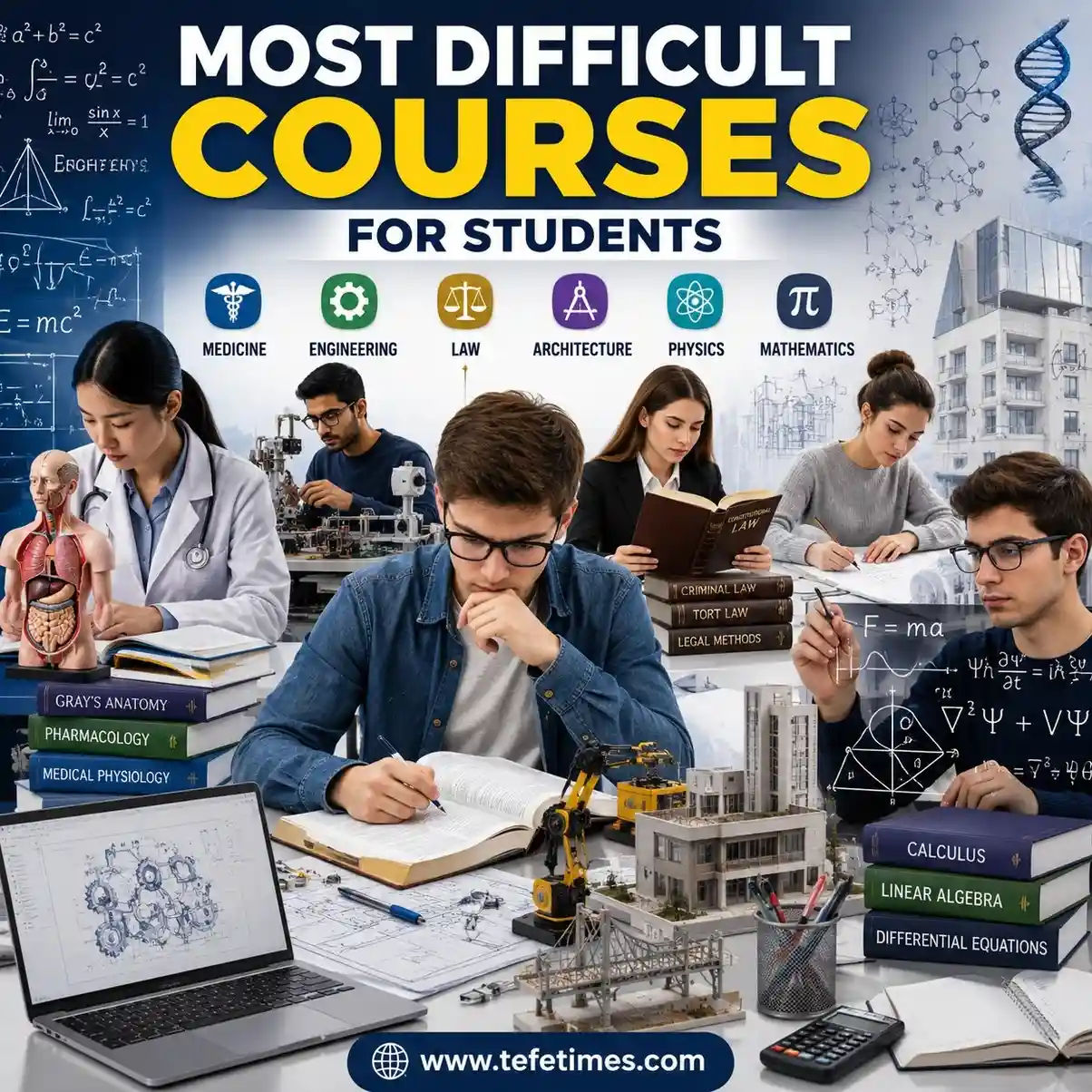
Most Difficult Courses for Students
Choosing a college course is one of the biggest decisions in life. While every field has its own challenges, some courses are widely known for their demanding workload, difficult concepts, and intense competition.
Many students ask: Which course is the hardest?
The answer depends on your interests, strengths, and career goals. A course that feels difficult for one person may be exciting for another. However, some programs consistently rank among the toughest worldwide because they require deep knowledge, long study hours, and strong problem-solving skills.
In this article, we'll explore the most difficult courses for students, why they are challenging, and how learners can succeed in these demanding academic journeys.
Search Intent Analysis
Primary Keyword
- Most difficult courses for students
Secondary Keywords
- Hardest courses in the world
- Toughest degree programs
- Difficult college majors
- Hardest university courses
Semantic Keywords
- Academic challenges
- Student success
- Career opportunities
- Intensive study programs
- Higher education
Search Intent
Informational
Users want to know which courses are difficult and whether they should pursue them.
Why Some Courses Are More Difficult Than Others
Not all courses demand the same skills. Some require:
- Advanced mathematics
- Practical training
- Critical thinking
- Research abilities
- Long study hours
- Emotional resilience
A difficult course often combines multiple challenges at once.
might you be wondering: Does difficult mean better?
Not necessarily. The best course is one that matches your passion and long-term goals.
1. Medicine
Medicine is often considered one of the hardest courses globally.
Why Is It Difficult?
- A massive amount of information to memorize
- Clinical training requirements
- Long study duration
- High responsibility toward patients
Medical students study subjects such as:
- Anatomy
- Physiology
- Pharmacology
- Pathology
- Surgery
Career Opportunities
- Doctor
- Surgeon
- Researcher
- Public health specialist
Average Study Duration
6–10 years, depending on the country and specialization.
Real-World Example
A medical student may spend years studying before becoming a licensed physician. Continuous learning remains necessary even after graduation.
According to the World Health Organization, healthcare professionals require lifelong learning due to constantly evolving medical knowledge.
2. Engineering
Engineering combines mathematics, science, and practical application.
Popular engineering branches include:
- Mechanical Engineering
- Civil Engineering
- Electrical Engineering
- Aerospace Engineering
- Computer Engineering
Why Is Engineering Hard?
- Complex mathematics
- Heavy laboratory work
- Technical problem-solving
- Project deadlines
Skills Required
- Analytical thinking
- Creativity
- Teamwork
- Technical expertise
Here's what works in real situations: students who regularly practice problems tend to perform better than those who only read textbooks.
3. Law
Law demands excellent reading, writing, and reasoning skills.
Why Is It Challenging?
- Thousands of legal cases to study
- Complex legal language
- Critical analysis requirements
- Competitive examinations
Law students often spend hours analyzing legal precedents and developing arguments.
Career Options
- Lawyer
- Judge
- Legal advisor
- Corporate consultant
4. Architecture
Architecture combines art, engineering, and design.
Many beginners struggle with this because it requires both creativity and technical precision.
Why Is Architecture Difficult?
- Intensive design projects
- Long studio hours
- Technical drawing
- Structural calculations
Students frequently work late into the night to complete models and presentations.
5. Physics
Physics is among the hardest academic subjects because it explains how the universe works using mathematics.
Topics Include
- Quantum mechanics
- Thermodynamics
- Electromagnetism
- Relativity
Physics requires strong problem-solving skills and abstract thinking.
Let's understand this with an example:
A student studying quantum mechanics must understand concepts that cannot be directly observed, making the subject mentally demanding.
6. Mathematics
Mathematics is often feared worldwide.
Advanced mathematics involves:
- Calculus
- Linear algebra
- Differential equations
- Statistics
Why Students Find It Difficult
- Abstract concepts
- Multi-step problem solving
- Logical reasoning requirements
However, students who practice consistently often improve dramatically.
Comparison Table: Most Difficult Courses
| Medicine | Memorization & practice | 6–10 years | Very High |
| Engineering | Mathematics | 4–5 years | High |
| Law | Reading & analysis | 3–5 years | High |
| Architecture | Design projects | 5 years | High |
| Physics | Abstract concepts | 3–5 years | Moderate |
| Mathematics | Problem solving | 3–5 years | High |
Benefits of Studying Difficult Courses
Although challenging, these programs offer significant rewards.
Key Benefits
- Strong career opportunities
- Higher earning potential
- Global recognition
- Personal growth
- Advanced problem-solving skills
Many graduates become leaders in healthcare, technology, business, and research.
Step-by-Step Guide to Succeed in Difficult Courses
1. Build Strong Foundations
Master basic concepts before moving to advanced topics.
2. Practice Regularly
Daily study sessions improve retention.
3. Join Study Groups
Learning with peers increases understanding.
4. Use Online Resources
Educational platforms and digital tools can simplify difficult concepts.
Best Tools and Resources for Students
Success in difficult courses often depends on using the right tools and learning resources.
Recommended Learning Platforms
| Khan Academy | Mathematics and Science |
| Coursera | University-level courses |
| edX | Professional certifications |
| PubMed | Medical research |
| Google Scholar | Academic papers |
Trusted educational organizations such as the World Health Organization (WHO) and UNESCO also provide valuable information for students and researchers.
Real-World Examples of Student Success
Medical Student Example
A student pursuing medicine may spend years preparing for examinations while completing hospital training. Despite the demanding workload, many doctors find the profession highly rewarding because they directly improve lives.
Engineering Student Example
Engineering students often work on practical projects that solve real-world problems, such as renewable energy systems or software applications used globally.
Law Student Example
Law graduates frequently contribute to justice systems, public policy, and business regulation worldwide.
These examples show that difficult courses often lead to meaningful and impactful careers.
Case Study: Overcoming Academic Challenges
Case Study 1: Engineering Student
A first-year engineering student struggled with calculus and physics. Instead of giving up, they:
- Created a study schedule
- Used online learning platforms
- Joined peer study groups
- Practiced daily exercises
Within two semesters, their grades improved significantly.
Case Study 2: Medical Student
A medical student found anatomy overwhelming because of the large amount of information to memorize. By using flashcards and active recall techniques, they increased retention and exam performance.
Here's what works in real situations: consistency often matters more than intelligence.
Common Mistakes Students Make
Many students struggle not because the course is impossible, but because of avoidable mistakes.
Common Errors
- Procrastinating assignments
- Ignoring fundamentals
- Studying only before exams
- Avoiding practical work
- Not asking for help
- Poor time management
You might be wondering whether top students never struggle.
The truth is that even high-performing students face difficulties. The difference is how they respond to challenges.
Practical Implementation Strategies
If you're considering a difficult course, follow these practical steps:
Before Choosing a Course
- Research career opportunities
- Understand the curriculum
- Assess your interests
- Evaluate long-term goals
During Your Studies
- Maintain a study schedule.
- Use active learning methods.
- Take regular breaks
- Seek mentorship
Budget-Friendly Learning Methods
Higher education can be expensive, but learning does not always require a large budget.
Affordable Strategies
- Use free online courses.
- Access digital libraries
- Watch educational videos
- Join community learning groups.
- Apply for scholarships
Students worldwide increasingly use digital learning resources to reduce costs while improving skills.
Expert Tips for Success in Difficult Courses
1. Develop Discipline
Motivation changes daily, but discipline creates long-term success.
2. Focus on Understanding
Memorization alone is not enough. Deep understanding improves retention.
3. Learn Time Management
Divide large tasks into smaller goals.
4. Stay Physically Healthy
Regular sleep, exercise, and proper nutrition improve academic performance.
5. Build Resilience
Difficult courses often test persistence as much as intelligence.
Many beginners struggle with this, but gradual improvement is normal.
Future Trends in Higher Education
The future of education is changing rapidly.
Emerging Trends
- Artificial Intelligence in learning
- Remote education
- Personalized learning systems
- Virtual laboratories
- Global online classrooms
Technology is making advanced education more accessible worldwide.
Are Difficult Courses Worth It?
The answer depends on your goals.
A difficult course can provide:
- High career growth
- Better earning opportunities
- Global recognition
- Intellectual development
However, success requires dedication and genuine interest.
Choosing a course only because it is prestigious may lead to frustration if it does not match your strengths.
Key Takeaways
- Difficulty varies from student to student.
- Medicine, engineering, law, architecture, physics, and mathematics are among the toughest courses globally.
- Success depends on consistency, planning, and effective learning strategies.
- Passion and interest are just as important as academic ability.
- Modern technology offers affordable ways to learn complex subjects.
Conclusion
The most difficult courses for students are not necessarily the best courses for everyone. What truly matters is finding a field that aligns with your interests, abilities, and long-term goals.
Challenging courses such as medicine, engineering, law, and physics require commitment, discipline, and resilience. Yet they also open doors to rewarding careers and opportunities to make a meaningful impact on society.
Remember: difficulty should not discourage you. With the right mindset, study habits, and support system, even the toughest academic paths can become achievable.
Education is not about choosing the easiest road—it is about choosing the right road for your future.
FAQ Section
1. Which course is considered the hardest in the world?
Medicine is often considered one of the hardest courses because of its extensive curriculum, clinical training, and long duration.
2. Is engineering harder than medicine?
Both are challenging in different ways. Engineering focuses heavily on mathematics and problem-solving, while medicine emphasizes memorization and practical training.
3. What is the hardest course for students who dislike mathematics?
Physics and engineering may be particularly difficult for students who struggle with mathematics.
4. Can average students succeed in difficult courses?
Yes. Consistent effort, good study habits, and proper support can help students succeed regardless of their starting level.
5. Which difficult course has the best career opportunities?
Medicine, engineering, and law generally offer strong career prospects globally.
6. How can students manage difficult courses effectively?
Students should create study schedules, practice regularly, seek help when needed, and maintain a healthy lifestyle.