
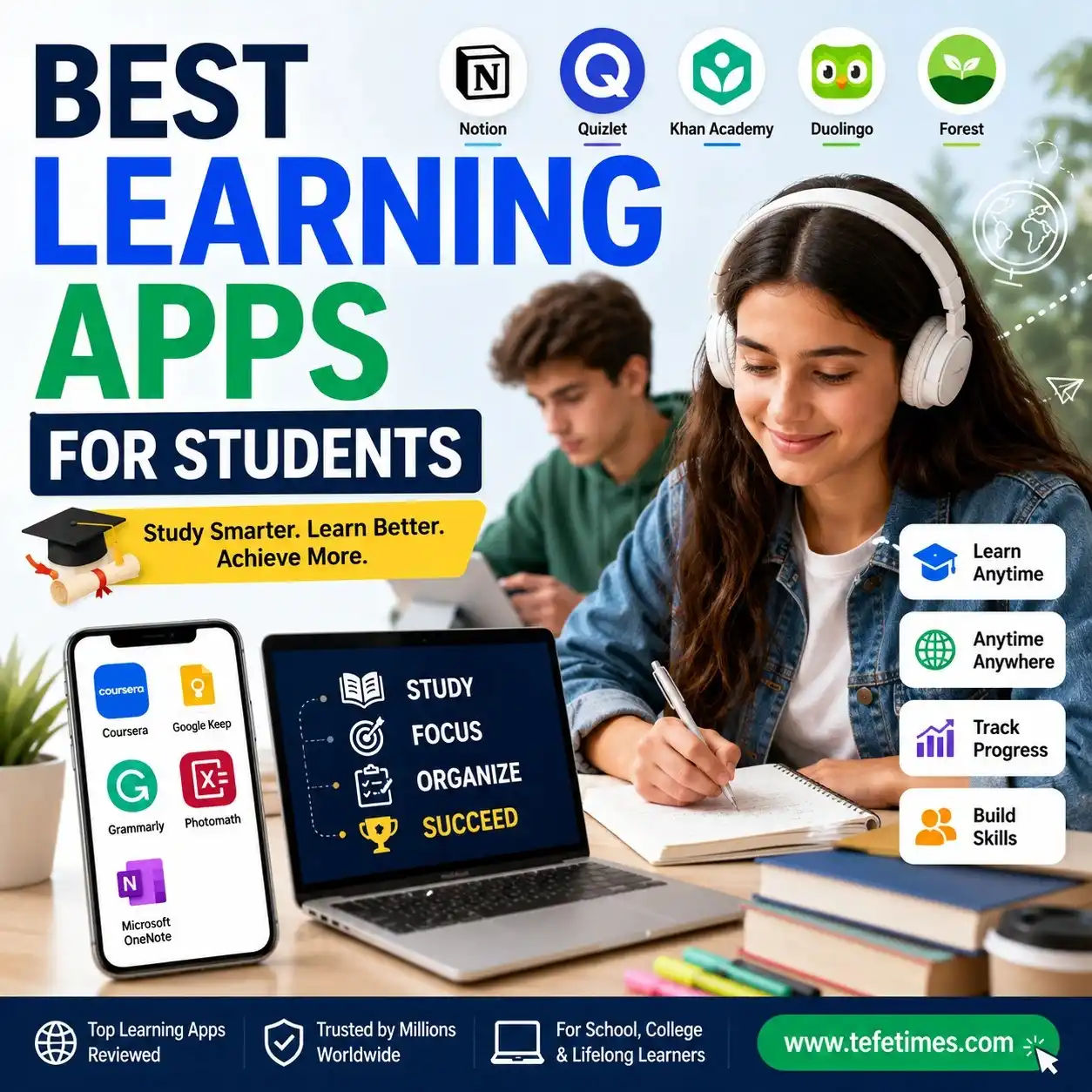
Education has changed dramatically over the last few years.
Students no longer rely only on textbooks, classroom lectures, or handwritten notes. Smartphones and tablets have become powerful learning tools that help students study faster, stay organized, and improve performance.
But here's the challenge.
Thousands of learning apps are available today. Choosing the right one can feel overwhelming.
Many students download apps that look impressive but provide little value. Others miss powerful tools that could significantly improve productivity and learning outcomes.
This guide explores the best learning apps for students in 2026, helping school students, college learners, professionals, and self-learners discover tools that genuinely make studying easier.
Whether you want better notes, stronger focus, language-learning support, math assistance, or improved productivity, you'll find practical solutions here.
Why Learning Apps Matter More Than Ever
Digital learning is no longer optional.
Students worldwide now use technology to:
- Take notes faster
- Improve memory retention
- Organize assignments
- Join online classes
- Learn new skills
- Practice languages
- Prepare for exams
- Manage time effectively
The right app can reduce stress while improving study efficiency.
You might be wondering:
"Can apps really improve academic performance?"
Research consistently shows that structured digital learning tools improve engagement, consistency, and accessibility.
The key is choosing wisely.
Features to Look for in Learning Apps
Before downloading any learning app, consider these factors:
| Easy Interface | Saves time |
| Offline Access | Learn anywhere |
| Cross-device Sync | Access materials everywhere |
| Progress Tracking | Monitor improvement |
| Affordable Pricing | Budget-friendly learning |
| Collaboration Features | Group study support |
| Personalized Learning | Better engagement |
Students often struggle because they focus only on popularity.
Practical usefulness matters more.
Best Learning Apps for Students in 2026
1. Notion
Best for: Organization and productivity
Notion helps students combine:
- Notes
- Assignment tracking
- Project planning
- Study schedules
- Task management
Many university students use it as an all-in-one academic dashboard.
Benefits:
- Highly customizable
- Works across devices
- Excellent collaboration tools
Best for:
College learners and online students.
2. Quizlet
Best for: Memorization and exam preparation
Quizlet remains one of the strongest study tools globally.
Students can create:
- Flashcards
- Practice quizzes
- Learning games
It works especially well for:
- Vocabulary learning
- Science concepts
- Historical facts
- Language education
Many beginners struggle with memory retention.
Quizlet solves this problem effectively.
3. Khan Academy
Best for: Free education
Khan Academy provides free educational lessons covering:
- Mathematics
- Science
- Economics
- Computing
- Test preparation
Its structured lessons help students learn at their own pace.
Advantages:
- Completely free
- High-quality teaching
- Beginner-friendly explanations
Budget-conscious learners especially benefit.
4. Duolingo
Best for: Language learning
Learning languages has become increasingly important globally.
Duolingo offers:
- Spanish
- French
- German
- Japanese
- Korean
- English improvement
Gamified lessons improve consistency.
Short daily sessions make language learning easier.
5. Forest
Best for: Focus improvement
Phone distractions hurt productivity.
Forest helps students stay focused.
Here's how it works:
- Set study time
- Virtual trees grow while staying focused.
- Leaving the app interrupts growth.
Simple psychology encourages discipline.
Ideal for:
- Exam preparation
- Deep study sessions
- Reducing social media distractions
6. Coursera
Best for: Professional skill development
Students increasingly need practical career skills.
Coursera provides courses covering:
- Programming
- Data science
- Business
- Marketing
- Design
- Artificial intelligence
Learners can build valuable skills beyond traditional classrooms.
7. Google Keep
Best for: Quick notes
Sometimes students need speed.
Google Keep offers:
- Fast note-taking
- Voice notes
- To-do lists
- Reminder systems
Minimal design improves usability.
Excellent for everyday academic organization.
8. Grammarly
Best for: Writing improvement
Strong writing skills matter globally.
Grammarly supports students by helping improve:
- Grammar
- Clarity
- Tone
- Readability
Particularly valuable for:
- Essays
- Emails
- Reports
- Research writing
9. Photomath
Best for: Mathematics learning
Math remains difficult for many learners.
Photomath helps students understand solutions step by step.
Subjects include:
- Algebra
- Arithmetic
- Equations
- Calculus fundamentals
Learning improves when students understand processes rather than memorizing answers.
10. Microsoft OneNote
Best for: Digital notebooks
OneNote helps students organize learning materials efficiently.
Useful features:
- Handwritten notes
- Images
- Audio recording
- Cloud synchronization
Ideal for:
- University students
- Research-heavy subjects
- Collaborative learning
Free vs Paid Learning Apps
Here's what works in real situations.
| Budget | Excellent | More advanced features |
| Accessibility | High | Premium tools |
| Customization | Moderate | Better personalization |
| Support | Community-based | Dedicated support |
Many students succeed entirely with free platforms.
Paid upgrades only make sense when advanced functionality becomes necessary.
Best Learning Apps by Student Type
School Students
Recommended:
- Khan Academy
- Quizlet
- Forest
College Students
Recommended:
- Notion
- OneNote
- Grammarly
Online Learners
Recommended:
- Coursera
- Notion
- Google Keep
Professionals
Recommended:
- Coursera
- Grammarly
- Duolingo
Common Mistakes Students Make
Many learners unintentionally reduce learning effectiveness.
Avoid these mistakes:
Downloading Too Many Apps
More apps do not equal better learning.
Choose 3–5 essential tools.
Ignoring Consistency
Learning requires regular practice.
Even excellent apps fail without consistency.
Focusing Only on Features
Practical usability matters more than complexity.
Skipping Progress Tracking
Measure improvement regularly.
Data creates motivation.
Budget-Friendly Learning Strategy
Students can build a powerful system without spending much.
Example setup:
Free combination:
- Khan Academy → learning
- Quizlet → memorization
- Forest → focus
- Google Keep → organization.
Cost:
$0
Effective systems do not always require premium subscriptions.
Future Trends in Learning Apps
Education technology continues to evolve rapidly.
Emerging trends include:
Personalized Learning
Apps increasingly adapt lessons to student performance.
Interactive Learning
Gamification improves engagement.
Voice-Based Learning
Voice search and audio education continue growing.
Smart Productivity Tools
Students increasingly combine organization with learning systems.
Technology will continue changing education worldwide.
Students who adapt early often gain advantages.
Expert Tips to Learn Faster
Practical strategies used by high-performing students:
- Use one productivity app consistently.
- Combine note-taking with active recall.
- Study in focused sessions
- Track progress weekly
- Limit distractions
- Build repeatable study routines.
Small habits create long-term improvement.
Real-World Example
A university student preparing for exams might combine:
- Notion → planning
- Quizlet → revision
- Forest → concentration
- Grammarly → assignment improvement
Instead of relying on a single tool, combining strengths yields better outcomes.
Looking for more education and technology insights?
Visit:
Final Thoughts
The best learning apps for students are not necessarily the most expensive or popular.
The right choice depends on:
- Learning style
- Goals
- Budget
- Academic needs
Start small.
Pick two or three tools.
Use them consistently.
Over time, small improvements create major academic growth.
Technology works best when paired with discipline and smart learning habits.
The students who combine both often achieve stronger long-term results.
FAQ Section
Which learning app is best for students?
Quizlet, Notion, Khan Academy, and Duolingo are among the top choices depending on learning goals.
Are learning apps free?
Many offer free versions. Premium plans provide additional features.
Which app improves study focus?
Forest remains one of the strongest focus-building apps.
Which app is best for online learners?
Coursera, Notion, and OneNote work well.
Can learning apps improve grades?
When used consistently, educational tools can improve organization, understanding, and study habits.
Final Reader Action Step
Choose one learning app from this guide today and use it consistently for the next 14 days. Small improvements in learning habits often create powerful long-term academic success.